Pages

Thursday, 10 April 2014

Reading Activity for Week 9 Term 1


SCHOOL JOURNAL PART 4 NUMBER 1, 1999, PAGES 26 - 28

Dianne’s Dream.  By Bill O’Brien

WALT: answer questions based on the text by looking for keywords in the questions.
Success Criteria: 1. I am able to identify and highlight the keywords in the question. 2. I am able to locate the keywords in the text and look for answers to the questions.

ACTIVITY 1 - READING RESPONSE
Read the text and then answer these questions based on the text.
1. Where did Dianne Hollands grow up?  Dianne Hollins grew up on a farm in Southland
2. What was Dianne's dream all about? Dianne’s dream was all about playing at Junior Wimbledon.
3. How long did Dianne spend training each day? Dianne spent training each day for at least 2 Hours.
4. What was Diannes greatest achievement? Dianne’s greatest achievement was when she joined Tsnuar Brown and Jane Ioaba as a member of the New Zealand at the Oceania World Junior qualifying Tournament
5. How old was Dianne when she won the Otago Premier Player of the Year? Dianne was 13 years old when she won the Otago Premier Player of the Year.

Activity 2 - Vocabulary
WALT:  1. Use an online dictionary. 2. Look for meanings of words from the text I have read.
Success Criteria: 1. I am able to use an online dictionary. 2. I am able to say  the meanings of words

Read page 1 of the story and look for these words in the text. Then use a dictionary to find the meanings of these words.

Words
Dictionary Meanings
1.   prestigious
Inspiring respect and admiration: having a high status.
2.   ambition
A strong desire to do or achieve something,typically requiring determination and hard work
3.   achievement
a thing done successfully,typically by effort,courage, or skill.
4.   tournament
A trial or skill in which competitors play  a series of contests.
5.   talent
A special natural ability or aptitude.
6.   dedicated
wholly committed to something, as to an ideal, political cause, or personal goal.
7.   professional
following an occupation as a means of livelihood or for gain.
8.   perfectionist
a person who adheres to or believe in perfectionism.
9.   popular
regarded with favour, approval, or affected by people in general
10. education
the act or process of imparting or inquiring general knowledge of something.

Friday, 21 March 2014

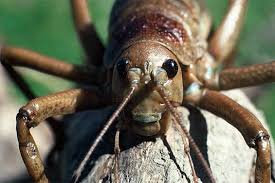
Facts about the Weta

Facts about the Weta


  • The Weta is only found in New Zealand and it is so old that it has outlived the dinosaurs.
  • Wetas have a rather musky smell, like a bat.
  • You can tell a female and a male apart because the female has a long ovipositor which looks stingier which it uses to lay eggs.
  • Wetas have knees on their front knees, and can feel the vibrations of noises around them.
  • There are 5 different types of Wetas.
Here is a picture and a link.
 

Thursday, 13 March 2014

Making Bread.


WALT: Write an explanation on making bread.
SC: My writing will have:
  • A title
  • An Identifying Statement
  • Explanation written in sequence
  • A summary statement
  • Nouns, present tense, verbs, and time and sequence words.
Making Bread:
Bread is made from wheat, which is then turned into flour.
To make bread you need flour, salt, water and yeast. First, in a mixing bowl, combine the water and the yeast.
Then add the flour and the salt and stir it thoroughly until it combines.
Next, cover the dough mixture with a  tea towel or a plastic wrap, and let the dough rise.
When it has risen to double the size, you can now bake it.
You will have to bake it for 5 - 10 minutes or until it is golden brown.
You can check if it is cooked by inserting a skewer inside.
After it is cooked, you can put it on a cooling rack for about 2 minutes. Now you can eat your yummy bread plain or with your favorite spreads.

My Reading Activity for Week 6


IN THE FOREST 3000 YEARS AGO

WALT: answer questions based on the text by looking for keywords in the questions.
Success Criteria: 1. I am able to identify and highlight the keywords in the question.
                              2. I am able to locate the keywords in the text and look for answers to
                                  the questions.

ACTIVITY 1 - READING RESPONSE - Read Page 18 of the Article and then answer these questions based on the Article.

1.  Why did the Moa Bird rush back to the shelter of the bush?
The Moa rushed back to the shelter of the bush because it saw a Haan’s Eagle coming.
2. What were the Takahe doing near the lake?
The Takahe was getting some grasses to eat.
3. Why did the Haast’s Eagle come rocketing down from the sky?
The Haast's Eagle came rocketing down from the sky because it saw a tasty snack.
4. As night fell, what noises could be heard from the forest?
As the night fell you could hear a Weka let out a strange bellow, and the incest let out a strange hum.
5. Why do the kiwi, kakapo and the weka birds roam the forest at night?
The Kiwi,Kakapo and the Weka birds roam the forest at night because it’s looking for food.

Activity 2 - Vocabulary

Make sentences with these words.

1.  investigate I went to investigate where the noise came from.
2.  background I went to the movies and  as I walked in, the was music in the background.
3.  shapes I see shapes in the dark and wondered what it was.
4.  roaming As I was walking in the dark in the forest, a Kiwi was roaming around, looking for food.
5.  covered I covered myself in a blanket because I was cold.
6.  suddenly Suddenly I woke up and I was hot.
7.  strange It was very strange.
8.  through When I was playing with my dog, the tennis ball went through into the house.
9.  followed My dog followed me as I went inside.
10. somewhere As I was looking for the ball, the dog went somewhere.

In the Weekends


In the Weekends.

SUNDAY:

On sunday, I had to wake up early to do Round The Bays in Parnell. When I woke up, I got changed into my clothes. Then I had breakfast. 
After that, we left and we drove to my mum’s work for a meeting, before we walked down to the bay. At the meeting, I heard that the walk was 8.4 Kilometres. 
When we had finished our meeting, we all started walking down to the bay. On the way down, we went one way but we had to go the other way because one side was blocked. The we saw Mrs Pome’e walking, so we said hi. 
Then we started walking the right way. When we got to where the starting line was, we stood and waited for when we could start. When we had started, we started running for 5 minutes. After that we started walking again. The time that I took till I crossed the finish line was 1 hour, 52 minutes and 30 seconds.
I had fun, and I also enjoyed myself, even though my feet hurt!

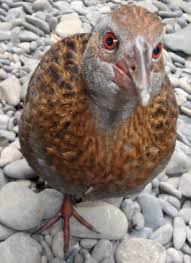
5 Interesting facts about a Weka


5 Facts About The Weka.The weka is a large, brown, flightless bird that has a famously feisty and curious personality.
Historically, the weka was a significant resource for some iwi, and the birds’ availability for sustainable harvest remains an important issue in weka conservation. Weka were also used by early European settlers, who gave it the name woodhen.
The weka’s best known call is a repetitive, loud ‘coo-et’ that is usually heard at dusk and in the early evening. It is presented as a duet, with the male giving the lower and slower part. Weka are usually heard, not seen, although some birds, usually those living near farms or tramping huts, get a reputation for pilfering crops, food and other small objects. They will take the objects to the nearest cover to investigate them. For this reason it is best not to chase weka but to simply watch where the weka goes and retrieve the objects a little later.
Here is a Picture of a Weka:
Here is a link for more information:
http://www.kcc.org.nz/weka

These two qualities traditionally made the bird an easy food source for Mäori and early European settlers.


Tuesday, 11 March 2014

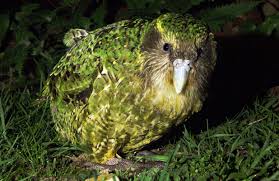
5 Facts about the Kakapo.


5 Facts about the Kakapo Bird.

  • Weighing up to 3.6 kilograms, the flightless kakapo is the heaviest parrot in the world. It is also the most endangered.
  • The kakapo lives on a diet of roots, leaves and fruit, and although it cannot fly, it is able to climb trees for food. It walks, rather than hops.
  • It has glossy yellow-green feathers and distinct facial feathers like those of an owl.
  • One factor which seems to trigger a successful breeding season is a "mast" year, when the rimu trees produce large amounts of fruit. The adult birds eat the fruit before it is ripe and just before they are ready to breed.The chicks later eat the seed from the ripened fruit and can increase their weight to up to 2 kilogram in the first 4 months of life.
  • Unfortunately a "mast" year will happen only every 3-5 years. Attempts are being made to supplement the feed of kakapo in the wild to try and artificially reproduce the best conditions for a breeding season.
Here is a Photo of a Kakapo, and a link for the information:Click to find out more about Kakapos